 Necdet Kıvcı, Founder · ·
Mercerised and sanforised are two words almost everyone in textiles has heard. The hotel buyer has heard them, and so has the person selling the sheets. Yet ask what they mean and the answer is usually short: “Mercerised means shiny fabric.” Sanforised passes by like just another label.
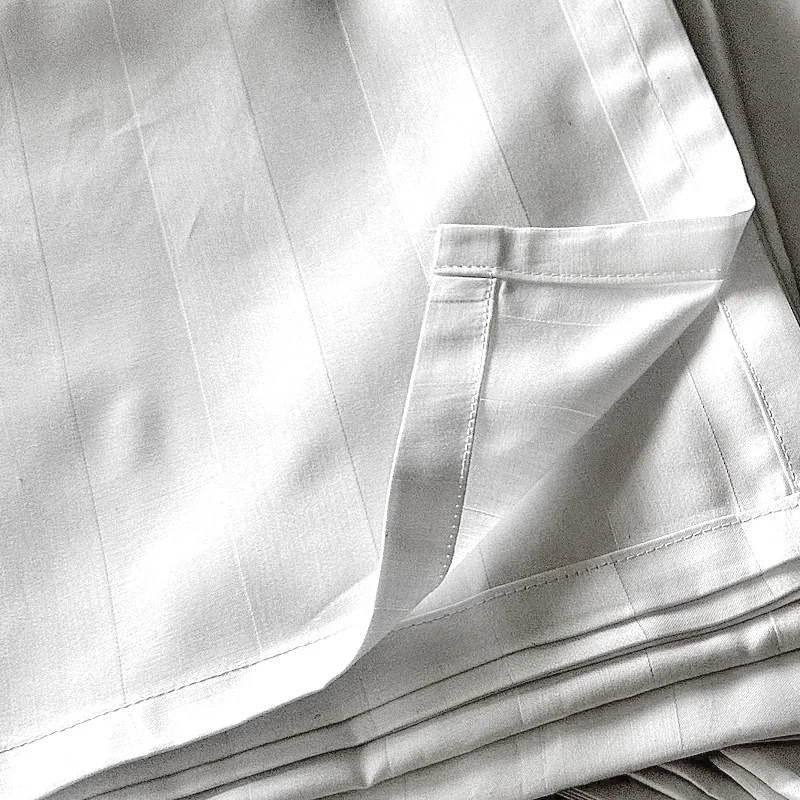
That short answer has a side effect. The market is full of fabrics with a high polyester content, and there are even “satins” woven from 100% polyester in the Far East. So when people see a shiny, smooth fabric, their first thought is polyester. Some of our customers are taken aback the first time they hold our mercerised combed cotton satin: “Is this really 100% cotton?” Yes, it is cotton. That sheen comes from the cotton itself. Let me explain how.
Why does cotton look matt?
If you could see a cotton fibre under a microscope, you would not see a straight thread but a flat ribbon twisted around itself. Its cross-section looks like a kidney, with a hollow channel in the middle. When light falls on this twisted, uneven surface, it scatters in every direction. That is why raw cotton looks matt.
Mercerising: making cotton round
In 1844 the English chemist John Mercer noticed that cotton swelled when soaked in cold, strong caustic soda (sodium hydroxide). The process is named after him. About half a century later, Horace Lowe added an important detail: if the fabric was held under tension during the treatment, a silk-like sheen appeared.
This is what happens. In the caustic bath the fibre swells, its kidney-shaped cross-section becomes round and its twists open out. Because the fabric is held taut, the fibre cannot shrink back, and its surface becomes smooth. A smooth surface does not scatter light; it reflects it evenly, like a mirror. The fabric is then washed while still under tension, and the caustic is removed completely. Nothing new has been added to the fabric; only the shape of the cotton fibre has changed.
The sheen is only the visible part. Mercerised cotton takes dye better, so colours come out deeper. The fibre becomes a little stronger, and the fabric feels fuller in the hand.
Doing this well is not easy. In a densely woven satin, it is hard for the caustic to reach the inside of the fibres. If the fabric is not well prepared, the caustic stays on the surface and the sheen comes out patchy. If the tension is released too early, the fabric shrinks and the sheen is lost. Good mercerising is patient, careful work at the dyehouse.
How it differs from the shine of polyester
The shine of polyester is a little cold and slippery. The sheen of mercerised cotton is softer and deeper. The fabric feels cool in the hand, absorbs moisture and does not make you sweat. Still, the surest way is to trust documents rather than your eyes. Ask for the fibre content in writing with the quote, and for large purchases have a laboratory test done.
Samples and testing: verifying the supplier’s word
Sanforising: a guarantee on size
Mercerising makes a fabric beautiful, but it does not stop it from shrinking. Shrinkage needs a separate process: sanforising.
While cotton fabric is woven and finished, it is constantly pulled and stretched lengthwise. In the first wash the fibres relax and try to return to their original state, and the fabric gets shorter. Sanforising lets the fabric go through this shrinkage at the mill, in advance. The dampened fabric is compressed lengthwise on a thick rubber belt and dried in that state. The extra length is taken out before the fabric ever reaches the sewing room.
The process takes its name from the American Sanford Cluett, who developed it in the late 1920s. It is not a chemical process but a purely mechanical one, done with heat and pressure, and it adds nothing to the fabric.
For a hotel this matters a great deal. In industrial washing, high temperatures and drying increase shrinkage. A fitted sheet sewn from sanforised fabric still fits the mattress after the first washes, and a duvet cover still fits the duvet. I explain shrinkage and size allowance in a separate article.
Ask about both
Mercerising gives a fabric its sheen, depth of colour and full hand. Sanforising keeps its size. One brings beauty, the other confidence. When you ask for a quote, ask about each separately: is the fabric mercerised, and is it sanforised? If it is not sanforised, has a shrinkage allowance been left?
Sanforising is an expensive process, and it shows in the price. Our fabrics are not sanforised; instead, we leave a shrinkage allowance when cutting. That way the product fits the size you ordered after it has been washed.
Our finest fabric is a 118-thread mercerised plain satin: combed cotton yarn Ne 60/1, 118 threads per centimetre, about 300 TC. If its sheen surprises you when you hold it, rest assured: it is 100% cotton.