Textile terms are used inconsistently across the market. We wrote these definitions drawing on many years of experience in hotel textiles and on research into technical and scientific sources, and we have tried to explain each term as clearly and accurately as we can. We do not claim they are the only correct definitions: they are how we use the terms. Other suppliers may use some of them differently, so it is always worth asking for the yarn, thread count or weight behind a name.
Weaves and fabrics
Plain weave
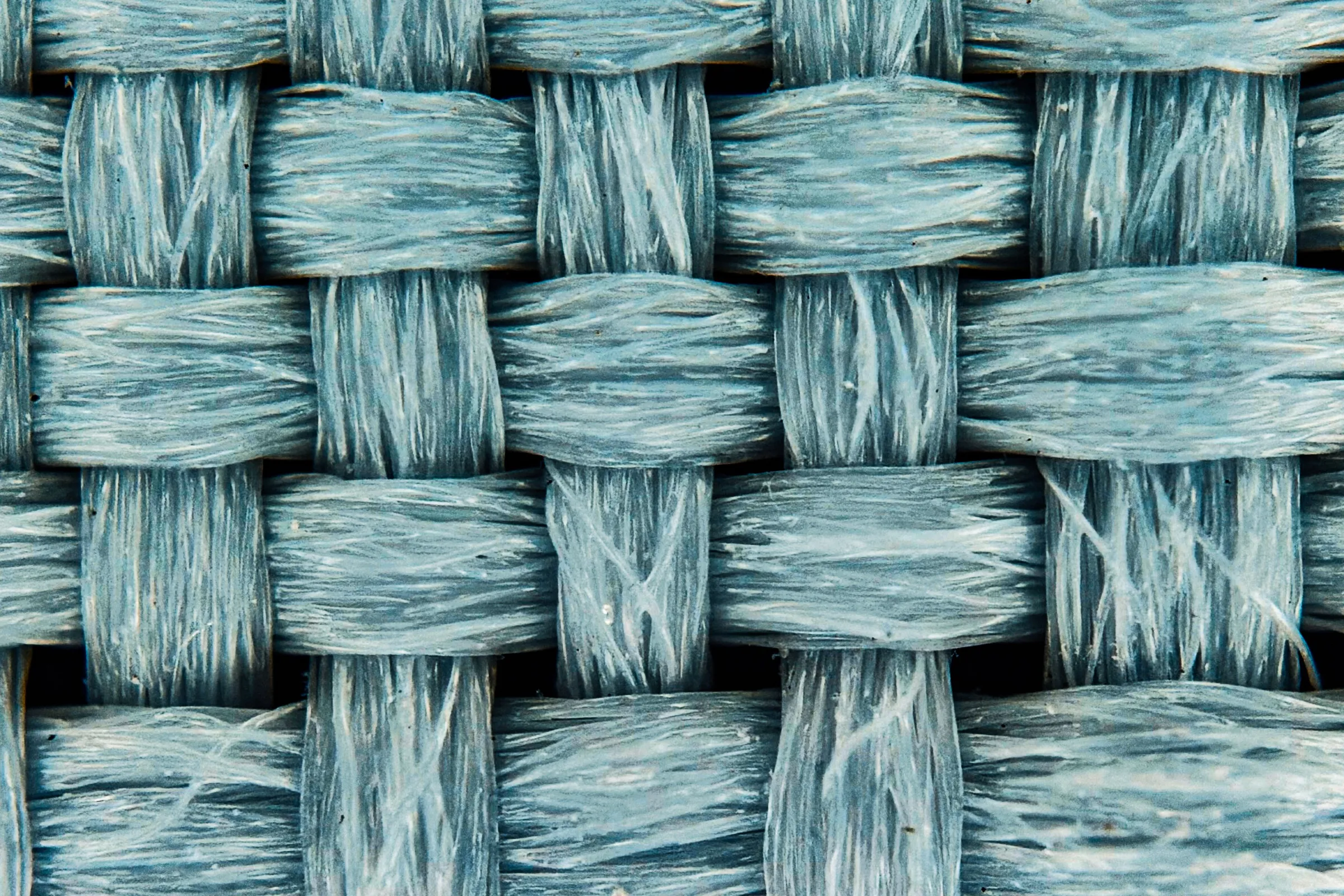
The simplest weave: the weft passes over one warp thread and under the next (1:1). Both faces of the fabric look the same. Ranforce and percale are both plain weaves; they differ in yarn fineness and density.
Ranforce
A plain-weave sheeting fabric. Matte, the same on both faces, and the most widely used fabric for bed linen.
Some sources call this fabric “poplin”. We say ranforce, because poplin usually brings shirting to mind.
At NK Aegean: Ne 20/1 or Ne 30/1 yarn, 53 to 62 threads/cm (≈ 135 to 160 TC). 100% cotton, or polyester warp with cotton weft (poly-cotton ranforce). The most common is 57 threads/cm. All qualities and widths are on our fabrics page.
Percale
A plain weave made from finer combed yarn and woven more densely than ranforce. Crisp, matte and cool to the touch.
How we use the names: a plain weave of 80 threads/cm or more is percale; ranforce goes up to 62 threads/cm.
At NK Aegean: 100% cotton, Ne 40/1 combed, 80 threads/cm (≈ 205 TC), singed. See our fabrics page.
Ranforce: 57 threads in 1 cm (29 warp + 28 weft)
Percale: 80 threads in 1 cm (40 warp + 40 weft)
Satin
A weave in which threads float over several others before going under. The floats reflect light, so the fabric is lustrous and smooth. The face and the back look different.
In English, cotton satin is often called sateen; “satin” can also mean a silk or polyester fabric. Ours is cotton or poly-cotton.
At NK Aegean: Cotton satin, 100% cotton, Ne 40/1 combed, 82 threads/cm (≈ 210 TC); poly-cotton satin, Ne 24/1, 83 threads/cm (≈ 210 TC). Plain or striped. For mercerised satin, see Mercerising. All qualities and widths are on our fabrics page.
Plain satin: 118 threads in 1 cm (59 warp + 59 weft)
Stripe satin, 118 threads in 1 cm: the edge of a stripe
Stripe satin (hotel stripe)
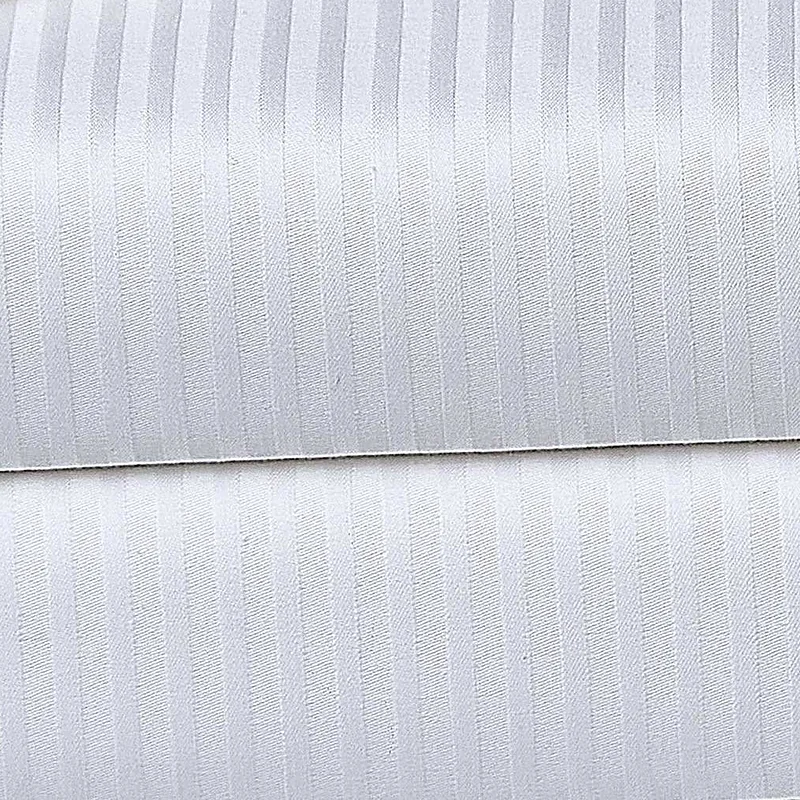
Satin woven with a fine stripe in the same colour as the fabric. The classic look of hotel bed linen.
At NK Aegean: Stripes from 0.5 to 3 cm. Cotton and poly-cotton satin with a 1 cm stripe or a 0.5 to 2 cm weft stripe; Ne 60/1 mercerised satin with a 1 cm or 3 cm stripe (3 cm in 300 cm width only).
Warp stripe and weft stripe
Whether the stripe runs along the fabric (warp direction) or across it (weft direction). It decides which way sheets and duvet covers are cut.
At NK Aegean: Weft-stripe satin, 0.5 to 2 cm, in 240 and 300 cm widths.
Dobby
Small geometric patterns, such as checks, squares and fine stripes, woven on a loom with a dobby device that lifts the shafts one by one. The pattern can be in the same colour as the fabric.
Check dobby
A dobby fabric with a small or large check pattern.
At NK Aegean: Cotton, Ne 8/1, 300 g/m² (± 5%).
Jacquard
Fabric woven on a jacquard loom, which can lift every warp thread on its own. It allows much larger and freer patterns than dobby: logos, flowers, lettering.
Piqué
A fabric with a raised, textured weave. In Turkey the word also means the light summer bedspread made from it. Our piqué fabrics are specified by weight (g/m²).
Waffle piqué
A weave with square raised cells, like a honeycomb or a waffle. Used for piqué covers and light bathrobes.
At NK Aegean: Poly-cotton yarn (50% cotton, 50% polyester), Ne 8/1, 240 g/m². Our waffle bedspreads and bathrobes are woven from the same yarn.
Quilted-look piqué
A heavy decorative piqué fabric that looks quilted.
At NK Aegean: Cotton, warp Ne 20/1, weft Ne 10/1, 370 g/m².
Terry
A woven fabric with loops (pile) on one or both faces. Its weight is given in g/m² or in grams per piece.
At NK Aegean: 100% cotton, in two qualities: standard towels Ne 16/1, ring-spun towels Ne 20/2. Weights are on the towels page.
Pile (loops)
The loops on the surface of a towel. The loops absorb the water; the denser and longer the pile, the fuller the towel, and the longer it takes to dry.
Border (dobby border)
A band near each end of a towel, woven without loops or in a different weave. It decorates the towel and strengthens its ends.
Selvedge
The firm edge formed on both sides of a fabric during weaving, which does not fray. Fabric width is measured from selvedge to selvedge.
Yarn, fibre and units
Ne (English cotton count)
A measure of yarn fineness. The higher the number, the finer the yarn: for the same length, Ne 60/1 weighs half as much as Ne 30/1. “/1” means a single yarn.
Single and two-ply yarn
“/1” is a single yarn; “/2” is two yarns twisted together. Ne 20/2 is two Ne 20/1 yarns twisted into one; it is stronger and more even than a single yarn.
At NK Aegean: Our ring-spun towels are Ne 20/2.
Twist
How tightly the fibres are wound around each other in a yarn. Twist makes the yarn strong; a low-twist yarn is softer but weaker.
Staple length
The length of the cotton fibre. Longer fibres give a finer, more even yarn that pills less.
Carded yarn
Yarn spun from fibres that have been combed once (carded). Short fibres stay in the yarn; it is economical and widely used.
At NK Aegean: We have fabrics in carded yarn.
Combed yarn
Yarn combed a second time after carding to remove the short fibres. It is more even, pills less and has more lustre.
At NK Aegean: Our percale, satin and mercerised satin are made from combed yarn.
Ring-spun yarn
Yarn spun on a ring spinning frame, with the fibres tightly twisted. It gives an even, strong yarn.
At NK Aegean: Ring-spun towels Ne 20/2; terry bathrobes Ne 16/1 ring-spun.
Open-end yarn (rotor-spun)
A spinning method in which the fibres are formed into yarn in a fast-turning rotor. It is faster and more economical than ring spinning; the yarn is slightly harsher and less lustrous.
At NK Aegean: We have fabrics in open-end yarn.
Poly-cotton
Fabric that combines polyester and cotton. Polyester adds durability and crease resistance; cotton adds moisture absorption and a natural handle.
At NK Aegean: Sheeting with a polyester warp and cotton weft: 65% cotton, 35% polyester. Where the yarn itself is a poly-cotton blend, as in waffle piqué or a blended weft, it is 50% cotton, 50% polyester.
Warp and weft
Warp threads run along the length of the fabric; weft threads run across it.
Threads per cm
The total number of warp and weft threads in 1 cm of finished fabric. This is how the Turkish market gives density: “57-thread ranforce”, “82-thread satin”.
TC (thread count)
The same density counted per inch, as international brands use it. Our conversion: threads per cm × 2.54, rounded to the nearest 5. Example: 118 threads/cm ≈ 300 TC.
Fabric weight (g/m²)
The weight of one square metre of fabric. For piqué, dobby and terry, weight is given instead of thread count.
Width
The width of a fabric from selvedge to selvedge.
At NK Aegean: Our sheeting fabrics come in widths from 165 to 300 cm.
Finishing
Bleaching
The process that removes the natural yellowish tone of raw cotton. White hotel textiles are made from bleached fabric.
Optical white
A brighter white with a slight blue tint, given by an optical brightener.
Mercerising
Treating cotton yarn or fabric with caustic soda while it is held under tension. The cotton fibre swells and its flat, twisted cross-section becomes rounder, so the surface reflects light more evenly. The fabric gains lustre, takes dye better and more evenly, and the fibre becomes stronger. Mercerising does not change the density of the fabric; the weaving does.
Not every shiny fabric is polyester: the lustre of cotton satin comes from the weave and from mercerising. More in our article Mercerised and sanforised.
At NK Aegean: Mercerised satin in Ne 40/1 combed, 95 threads/cm (≈ 240 TC), and Ne 60/1 combed, 118 threads/cm (≈ 300 TC). Ne 60/1 is our finest sheeting fabric. See our fabrics page.
Singeing
Burning off the protruding fibre ends on the surface of the fabric with a flame. The surface becomes smoother and pills less.
At NK Aegean: Our satin and percale are singed.
Calendering
Passing fabric between heated rollers under pressure. The surface becomes flatter, with more lustre and a fuller handle. The effect fades with washing.
Finishing agent
A chemical applied to fabric for handle, softness or body. Part of it washes out in the first washes, so the true handle of a fabric shows after washing.
Sanforising
A mechanical process that pre-shrinks fabric to reduce shrinkage in the wash.
Shrinkage
The reduction in length and width after washing, given in per cent.
At NK Aegean: We allow for shrinkage when cutting; the sizes we give are finished sizes after washing.
Pilling
Small balls of fibre that form on the surface with use and washing. More common with short fibres and low-twist yarn; combed yarn and singeing reduce it.
Colour fastness
How well a colour resists washing, light, rubbing or perspiration. It matters for coloured hotel textiles, especially those washed at high temperatures.
Yarn-dyed
Fabric whose yarn is dyed before weaving. The colour lasts longer.
At NK Aegean: Blue poly-cotton ranforce.
Piece-dyed
Fabric dyed in the roll after weaving. Common for plain-coloured fabrics.
Products
Duvet cover
The cover for a duvet. (In German “Bettbezug”; in Swiss German “Duvetbezug”.)
Duvet cover set
Usually a duvet cover and pillowcases; no sheet.
Bed linen set
A duvet cover, a sheet and pillowcases.
The two names are often used interchangeably. When you ask for a quote, just say whether a sheet is included.
Flat sheet
A plain sheet tucked in under the mattress.
Fitted sheet
A sheet with elasticated corners that fits over the mattress. The skirt depth is chosen to suit the mattress height.
Skirt (mattress depth)
The part of a fitted sheet or mattress protector that wraps the side of the mattress. It is chosen a few centimetres deeper than the mattress, so the sheet holds underneath.
Pillowcase and hotel flap
A hotel pillowcase has an inner flap that keeps the pillow from slipping out.
At NK Aegean: 50 × 70 and 60 × 80 cm, with a 20 cm flap. See our bed linen.
Oxford border
A flat fabric frame around all four sides of a pillowcase, set off by a line of stitching.
At NK Aegean: On 60 × 80 cm pillowcases, with a 20 cm flap.
Duvet
The filled cover that goes inside the duvet cover. The filling can be fibre, goose down or wool; its warmth is given by the filling weight.
Bedspread
A decorative cover laid over the bed during the day. In hotels it is usually made of piqué or quilted fabric.
Bed runner
A narrow decorative band laid across the foot of the bed. An easy way to add colour to a hotel room.
Quilted
Two layers of fabric with a fibre wadding between them, held together by stitching. Used in mattress protectors and duvets.
At NK Aegean: 110 g/m² fibre wadding in mattress protectors.
Waterproof mattress protector
A cover with a breathable membrane that protects the mattress from liquids.
At NK Aegean: 20 micron TPU membrane; cotton woven or terry top; fitted skirt (35 or 40 cm) or four elastic corner straps. See our mattress protectors.
Bathrobe
A robe worn after bathing, at the spa or by the pool.
At NK Aegean: Two types: a thick cotton terry bathrobe (1,050 g each) and a light waffle piqué bathrobe for spa and pool (770 g each). See our bathrobes.
Ordering and use
Industrial laundering
The frequent, high-temperature washing of hotel and hospital laundries. Our products withstand industrial washing up to 90 °C; the ideal temperature is 40 °C. High temperatures shorten their life: about 200 washes instead of about 300.
Fabric swatch card
A card with small pieces of our fabric qualities.
Sample
A product sent before the order. The approved sample is the reference for production.
MOQ (minimum order quantity)
The smallest order for which production of an item can start. It exists because setting up weaving, dyeing and sewing is not economical below a certain quantity; for items made from stock it is usually lower.
Lead time
The time from order confirmation (often from prepayment) to delivery or loading. Short when the fabric is in stock; longer when special weaving or dyeing is needed.
Proforma invoice
A preliminary invoice issued before the order, showing the products, prices, delivery and payment terms. Prepayment and import formalities are based on it.
Private label
Production under the customer’s own brand, label and packaging. Labels and packaging are priced separately, according to the customer’s specification.
Woven label
A fabric label with the logo or brand name woven in thread. It withstands washing better than a printed label.
Embroidery
A logo or monogram stitched onto the product in thread.
RFID chip
A small, wash-resistant identification tag sewn into the product. It makes counting and tracking items in the laundry and the store room easier.
At NK Aegean: Sewn in on request.
Incoterms (EXW, FOB, DAP, DDP)
International abbreviations that show where transport, insurance, customs and duties pass to the buyer.
EXW (Ex Works): the goods are handed over at the seller’s premises; transport and customs are the buyer’s.
FOB (Free on Board): the seller clears the goods for export and loads them onto the ship; sea freight, insurance and import are the buyer’s.
DAP (Delivered at Place): the seller brings the goods to the buyer’s address; import duties and customs are the buyer’s.
DDP (Delivered Duty Paid): the seller delivers the goods to the buyer’s address with customs and duties paid.